Golden Seams: The Case for Repairing the Deals America Throws Away
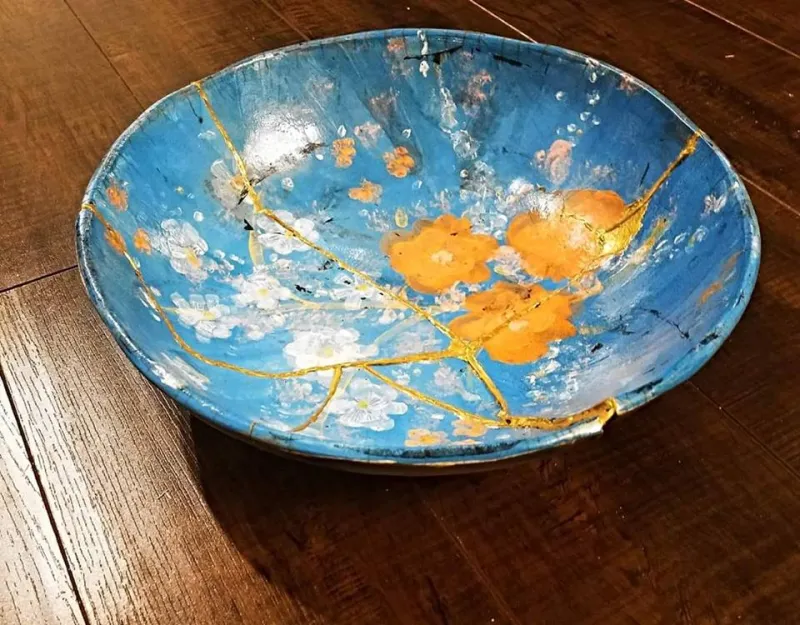
Photo: Ruthann Hurwitz, CC BY-SA 4.0, via Wikimedia Commons
There is a moment in nearly every strained business relationship when an executive quietly begins the search for a replacement. The vendor missed two shipments. The integration partner missed its milestones. The acquisition's cultural fit, once described as 'excellent,' now feels like a euphemism someone regretted signing. Rather than confront the fracture, we source around it. We onboard a new supplier, launch a new pilot, restructure the deal — and file the old relationship under lessons learned.
It is a habit so ingrained in American commerce that we rarely recognize it as a philosophy. But it is one: the belief that damage diminishes value, and that the professional response to a break is disposal.
Japan's kintsugi tradition rests on the opposite premise. When a ceramic bowl fractures, the artisan does not hide the repair. Lacquer dusted with gold traces every seam, transforming the object's history of breakage into its most distinctive feature. The bowl is not restored to what it was; it is made into something the original never was — more valuable, in many collections, than an unbroken piece.
The question for American leaders is not whether kintsugi is charming. It is whether some of the relationships we discard are, in fact, repairable at a cost lower than replacement — and whether the repair itself produces value a clean replacement never could.
The True Cost of a Clean Break
Replacement feels efficient because its costs are visible and its benefits are immediate. A new vendor arrives without baggage. A restructured deal comes with fresh terms. What the ledger rarely captures is what walks out the door with the old relationship: institutional knowledge of your specifications, relationships with your people, hard-won understanding of your failure modes.
The supply chain crises of recent years made this plain. Companies that severed ties with struggling suppliers during the disruption often discovered, eighteen months later, that their new partners carried their own fragilities — and that the 'unreliable' supplier's problems had been a temporary capacity shock, not a character flaw. Some of those firms spent more rebuilding the relationship from scratch than the original repair would have cost. A few found the old supplier unwilling to take them back.
There is also a quieter cost: signaling. Every abandoned partnership teaches your market how you behave under strain. Suppliers, joint-venture partners, and acquisition targets price that behavior in. An organization known for walking away at the first fracture will find that partners hedge, disclose less, and invest less in the relationship. The option to leave cheaply is not free.
A Framework for Deciding What to Mend
Not every break deserves gold. Kintsugi is selective; artisans decline pieces whose repair would compromise the object's integrity. Leaders need a similar discipline. Three questions help separate the repairable from the genuinely finished.
Was the breakage caused by structure or by character? A partner that failed because of a port closure, a labor shortage, or a mispriced contract has a structural problem — and structures can be redesigned. A partner that failed because it concealed bad news, or repeatedly chose its convenience over its commitments, has a character problem. Repair the structural breaks. Exit the character breaks, cleanly and without ceremony.
Does the relationship hold knowledge that cannot be re-created? Post-merger integrations illustrate this vividly. Studies consistently find that a large share of mergers fail to deliver projected value, and the failures cluster around the loss of tacit knowledge — the unwritten know-how that leaves when key people depart or when a struggling division is quietly wound down. If the damaged asset is, at its core, a repository of irreplaceable knowledge, repair usually beats replacement.
Can the repair be made visible? This is the part American executives resist most. A repaired relationship that both parties pretend was never broken will crack along the same seam. The kintsugi discipline requires acknowledging the rupture explicitly: revised governance, new escalation paths, renegotiated terms, and a shared written account of what failed and why. The gold is not decoration; it is documentation.
What a Mended Deal Looks Like
Consider a midwestern manufacturer whose long-time component supplier missed delivery commitments through two consecutive quarters. The conventional move is dual-sourcing and a gradual phase-out. The kintsugi move is different: an executive-level review that names the failure plainly, a joint investment — perhaps the buyer finances capacity upgrades in exchange for pricing and priority guarantees — and a governance cadence that makes recurrence detectable early.
Done well, the result is a relationship stronger than the original, because both parties now know exactly where it broke and have built around that point. The seam becomes the strongest part of the vessel. Competitors cannot replicate it quickly, because it was forged in a rupture they never shared.
The Executive's Choice
None of this argues for sentimentality. Some deals should die; some partners have earned their exit. But American business would be healthier if leaders could say, with a straight face, that they chose abandonment after a genuine repair analysis rather than as a reflex.
Kintsugi's deeper lesson is not about pottery at all. It is that an object's history of damage, honestly acknowledged and skillfully addressed, can become the basis of its value. Companies are not exempt from that arithmetic. The most resilient partnerships in any portfolio are usually the ones that have already broken once — and been put back together on purpose.