Trust the Chef: What Omakase Teaches American Managers About Surrendering Control
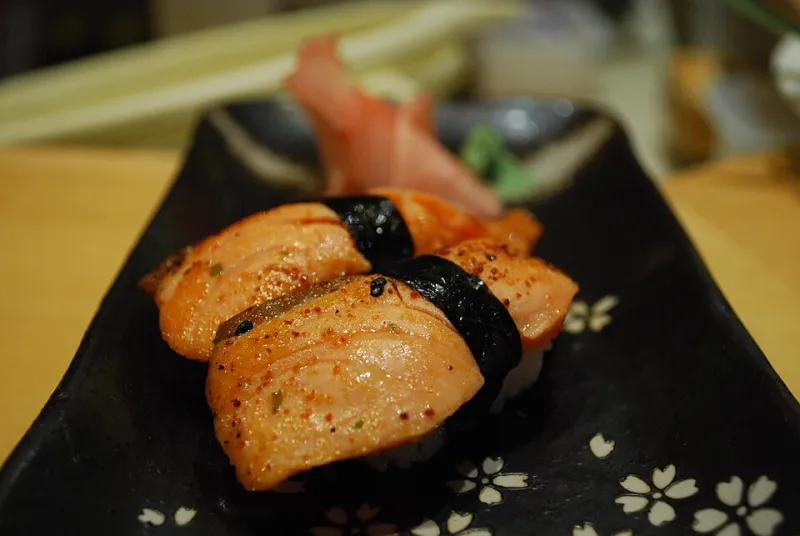
Photo: Alpha from Melbourne, Australia, CC BY-SA 2.0, via Wikimedia Commons
There is a moment, familiar to anyone who has sat at a high-end sushi counter in Tokyo or, increasingly, in New York or Los Angeles, when the menu disappears. The customer looks up and says a single word: omakase — roughly, 'I leave it up to you.' From that point forward, the chef decides. What is freshest tonight, what comes first, how long the pause between courses should last. The diner does not ask for a progress report. There is no dashboard tracking the chef's output in real time.
And yet, of all dining experiences, omakase commands some of the highest prices and inspires the fiercest loyalty in American food culture. A dozen seats, a tasting menu with no choices, and a waiting list that can stretch for months. It is worth asking why the same formula so rarely appears in our offices.
The Micromanagement Problem We Keep Renaming
American management culture has a complicated relationship with control. We celebrate 'empowerment' in town halls, then check the shared doc at 10 p.m. We install activity trackers, require daily standups, and ask for 'quick syncs' that function less as synchronization and more as inspection. The vocabulary has softened over the decades — supervision became oversight, oversight became alignment — but the underlying posture is unchanged: the manager watches, the employee performs.
This is not a new critique. What is new is the evidence that it is failing on its own terms. Gallup's workplace research has consistently found that fewer than one in three American employees strongly agree they have the trust of their leadership. Meanwhile, the tools of transparency multiply: shared dashboards, open calendars, read receipts. We have more visibility into each other's work than any generation of managers in history, and trust has not followed. Visibility, it turns out, is not intimacy.
The omakase counter suggests a different equation. The chef's authority is not threatened by the customer's surrender — it is created by it. Remove the customer's ability to specify, and you force the chef to be genuinely excellent rather than merely compliant. Compliance can hide behind specifications. Excellence cannot.
Designing the Omakase Moment
None of this argues that managers should simply announce 'trust me' and walk away. Trust at the sushi counter is earned across years of visible craft; the customer surrenders because the chef has demonstrated mastery. The lesson for American managers is not to demand surrender but to design for it — to create deliberate moments where control is formally, structurally handed over.
Consider what this looks like in practice:
- The unbriefed presentation. Send a capable team member to the client meeting with no slide deck to review beforehand and no manager in the room. Not as a stunt, but as a policy. The client meets the work, not the chaperone.
- The no-revision deliverable. Once per quarter, let a team ship something — a report, a design, a proposal — with a single review, not three. The reviewer's role shifts from co-author to audience.
- The chef's-choice project. Assign a problem, not a method. Define the outcome and the deadline; leave the path entirely to the people doing the work. Then resist the urge to ask how it's going until the agreed checkpoint.
Each of these is small. Together they send a signal that no engagement survey can: we hired you because we believed you could do this, and we are acting on that belief.
What Surrender Buys
The loyalty effect is the part American managers most often miss. The omakase diner does not leave saying 'the chef followed my instructions well.' There were no instructions. The diner leaves saying 'no one else could have made that evening.' Surrender converts a transaction into a relationship, because the thing received could not have been specified in advance — it existed only through the trust that produced it.
The same transformation happens inside companies. Employees who are watched do competent work and update their résumés. Employees who are trusted do work they will defend in rooms where the manager isn't present. In an economy where skilled people can leave as easily as they arrived, that distinction is not sentimental. It is the retention strategy.
There is a caution here, and it belongs to the chef as much as the diner. Omakase is a covenant in both directions: the customer gives up control, and the chef accepts total responsibility for the outcome. Managers who want the first half of that bargain without the second — who ask for trust but keep the escape hatch of blame — will find the ritual collapses quickly. Surrender without accountability is just negligence with better branding.
Letting Go as a Leadership Skill
The hardest part of management, it is sometimes said, is not telling people what to do. It is stop telling them what to do. American business culture, with its bias toward visibility and control, has built elaborate systems for the first and almost none for the second.
The sushi master at the counter does not explain every choice. The fish arrives, the season speaks, the customer eats. What looks like theater is actually the highest form of professional respect: the belief that mastery, given room, will deliver more than instruction ever could.
Somewhere in your organization this week, there is a person waiting for their omakase moment — a project they could own entirely, a meeting they could run alone, a decision they could make without a second sign-off. Hand it over. Then sit down, and trust the chef.