Whose Name Is on It? Recovering Personal Accountability in the Age of 'The Team Decided'
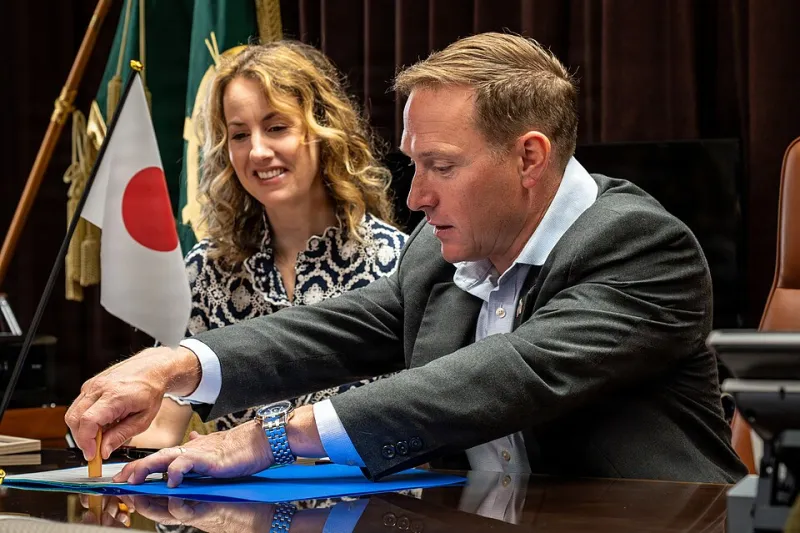
Photo: U.S. Air Force photo by Airman 1st Class Jessel Fabara, Public domain, via Wikimedia Commons
Ask a Japanese businessperson to authorize a contract, approve an invoice, or accept a shipment, and the transaction ends with a small red impression: a hanko, a carved seal bearing that individual's name. The stamp is modest—often made of ivory, horn, or boxwood, small enough to live in a shirt pocket—but what it represents is not. When the seal touches paper, a specific human being has accepted responsibility. Not a department. Not a committee. A person, with a name, a reputation, and a career that rises or falls on the quality of what they just signed.
American corporate life has evolved in precisely the opposite direction. We have built elaborate machinery for making responsibility vanish.
The Anatomy of Diffuse Blame
Consider the vocabulary. "The team decided." "Leadership has determined." "Per our review process." "Legal flagged it." Each phrase is a small act of displacement, moving the decision from a person to a fog. Nobody in the meeting asked for the fog. It accumulated on its own, one hedged email and one risk-averse legal review at a time.
The costs are familiar to anyone who has chased an answer through a Fortune 500 org chart. Clients can't tell who owns their account. Vendors receive contradictory instructions from three people who each assume another approved the change. When something breaks, the post-mortem produces a timeline but rarely a name. Employees, sensing the pattern, learn to route every consequential choice through the collective—because the collective cannot be fired.
This is not a process problem. It is a philosophy problem, and it is worth asking what we actually believe about accountability. Increasingly, the honest answer is: not much.
What the Seal Actually Says
The hanko is sometimes dismissed as bureaucratic anachronism—a rubber stamp in kimono. That reading misses the point. The seal does two things at once that our digital approval workflows somehow accomplish neither.
First, it is personal. You do not stamp with the company seal until you have stamped with your own. The individual mark precedes and authorizes the institutional one. The order matters. It says: before the organization commits, a person has.
Second, it is permanent. A red impression cannot be quietly edited, versioned away, or attributed to a misconfigured automation. It sits on the page like a signature in wet cement. In an era when Slack messages scroll into oblivion and decisions are buried in ticketing systems, the physical finality of the seal is a feature, not a bug.
American business once understood this. The bank signature card. The notary's embosser. The engineer's stamp on a set of blueprints—still, in licensed professions, a legal declaration that a named human stands behind the work. We did not lose the concept; we quietly retired it from ordinary business, reserving personal sign-off for the professions where failure kills people. The implicit message to everyone else: your work is not the kind worth putting your name on.
A Framework for Naming Names
Reinstating personal accountability does not require importing wooden seals or romanticizing Edo-period commerce. It requires a deliberate reversal of the diffusion instinct. We suggest a four-part framework, drawn from what we have watched work in Japanese-influenced organizations and increasingly in their American counterparts.
1. The Named Signatory Rule. Every high-stakes deliverable—client proposals over a defined threshold, pricing decisions, public commitments, post-incident reports—carries the name of one accountable owner. Not a distribution list. One name, chosen in advance, visible to the client. If the client cannot answer "who owns this?" in five seconds, the rule has failed.
2. The Stand-Behind Statement. Borrow from the engineer's stamp. Attach a brief, explicit declaration: "I have reviewed this and stand behind it." The sentence costs nothing and changes everything, because writing it forces the author to decide whether they actually do.
3. The Reverse Blame Test. Before adopting any new process, ask: does this make it easier or harder to identify who decided? Approval chains that add reviewers without adding owners are blame-diffusion engines wearing the costume of governance. Cut them.
4. Public Consequence, Public Credit. Accountability only functions if it runs in both directions. Name the owner when the launch succeeds. Name the owner when it fails—and protect them from ritual punishment, or you will simply teach everyone to hide again. The goal is not fear. It is the restored understanding that individuals, not committees, do things worth trusting.
The Trust Dividend
There is a commercial argument here that goes beyond internal hygiene. Clients, particularly American ones exhausted by vendor sprawl and account-manager churn, respond powerfully to a named human. "I own this account. My name is on it" is a competitive differentiator precisely because almost nobody says it anymore.
The Japanese craftsmen and merchants whose traditions inform this publication understood something we keep having to relearn: trust is not an organizational property. It transfers person to person, and it attaches to names. A seal is small. What it commits is enormous.
Somewhere between the diffusion of the org chart and the anonymity of the approval queue, American business forgot to ask the simplest governance question there is: whose name is on it? The companies that remember first will find that clients have been waiting for someone to answer.