Before the Terms, the Tea: How Deliberate Delay Is Quietly Changing the American Deal
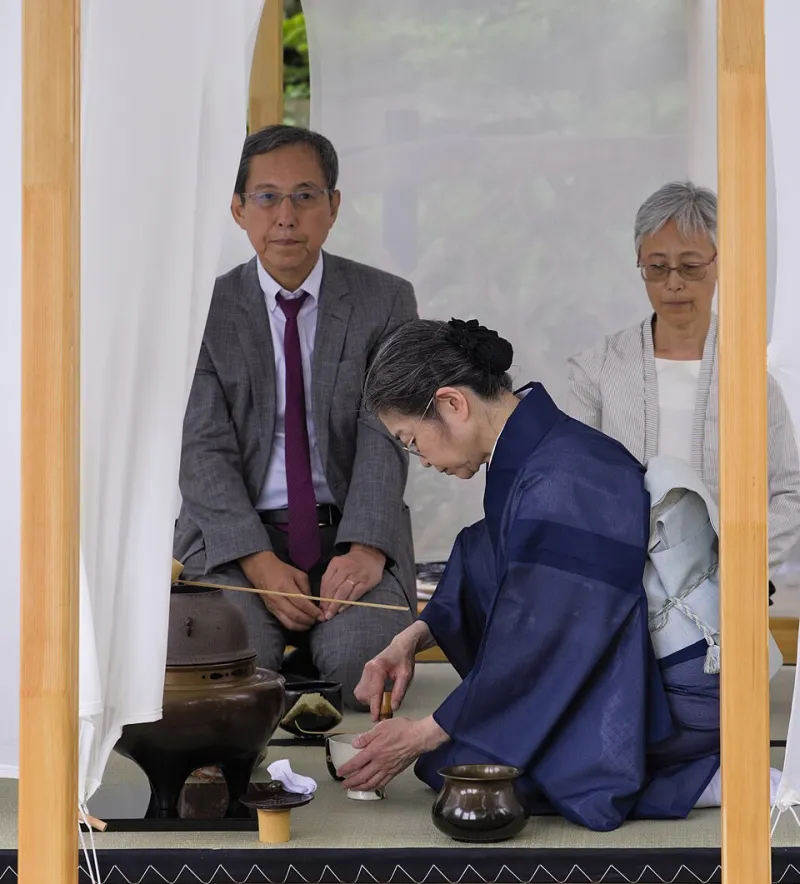
Photo: D-Kuru, CC BY-SA 4.0, via Wikimedia Commons
In the conference rooms of midtown Manhattan and the glass-walled suites of Silicon Valley, a quiet experiment is underway. Attorneys, brokers, and corporate development officers—professionals whose livelihoods depend on closing—are learning the value of not closing. Their inspiration comes from an unlikely place: the tea room of a Japanese ryokan, and a philosophy that treats delay not as friction but as foundation.
The Ritual Before the Reckoning
In Japan, the serving of tea before a business discussion is not a pleasantry to be waved away. It is a structured interlude—a moment in which hosts and guests alike acknowledge one another as people before they become counterparties. The tea is poured, admired, and drunk in a deliberate sequence. Nobody discusses price. Nobody pushes a term sheet across the table. The pause itself carries the message: this relationship will not be rushed.
American business culture, by contrast, treats time as a cost to be minimized. Meetings start at the top of the hour and end when the agenda is exhausted. Small talk is a toll paid grudgingly on the way to the substance. The assumption is that efficiency signals competence.
But a handful of dealmakers have begun to question that assumption, and their experiments are producing results worth examining.
The Attorney Who Schedules the Pause
Consider the approach of a mergers and acquisitions attorney in Chicago—we'll call her practice what it is: a mid-sized firm advising family-owned manufacturers on succession sales. Two years ago, she restructured her negotiation calendar around a simple rule borrowed from her study of Japanese business etiquette. No valuation discussion occurs in the first meeting. Ever.
The first session, instead, is built around what she calls the long pour: a meal, a facility tour, an unhurried conversation about the founder's history with the company. Only in the second meeting—often a day later—do numbers enter the room.
Her observation after dozens of deals: sellers who feel heard before hearing a number negotiate less defensively, disclose problems earlier, and walk away from the table less often. The pause, she argues, is not lost time. It is due diligence of a different kind—diligence about the human being across the table.
Why Silence Outperforms Pressure
Behavioral research offers some support for what these practitioners have discovered intuitively. Negotiators under time pressure anchor more aggressively and concede less gracefully. When parties are given room to reflect, offers tend to migrate toward the middle, and post-deal satisfaction—critical in relationships that must outlast the signing—measurably improves.
There is also a signaling effect. In a culture where everyone races, the person who declines to race stands out. A real estate developer in Seattle describes his practice of scheduling property negotiations with a built-in gap between first contact and first offer—a deliberate beat, sometimes several days, in which neither side pushes. Sellers, he finds, interpret the space as confidence. Desperation closes mouths; patience opens them.
This is the paradox at the heart of the tea-room model: the pause is not an absence of action but an action itself. It communicates that the deal is not the relationship, and that the relationship is what endures.
The Third Cup
Veterans of Japanese hospitality sometimes speak of the third cup of tea—the point at which ceremony gives way to candor. The first cup is courtesy. The second is comfort. The third is where the real conversation begins, because trust has had time to steep.
American negotiators adapting this idea need not import the ceramics. What translates is the architecture: a designed sequence in which rapport precedes terms, silence is permitted to do its work, and speed is recognized as one tactic among many rather than a virtue in itself.
The implications for leadership extend beyond the deal room. Executives who negotiate this way often report a spillover effect into how they run meetings, handle performance conversations, and manage crises. The discipline of waiting—truly waiting—turns out to be trainable.
Patience as a Competitive Position
None of this argues for slowness as a strategy in itself. Deals still have deadlines, and markets still move. But the practitioners profiled here share a conviction worth taking seriously: that most negotiating losses are not failures of preparation but failures of patience. The information needed to close well was in the room all along; it simply needed time to surface.
At Miyake, we have long believed that the oldest crafts survive not because they resist change but because they understand timing. The tea master does not rush the water. The negotiator, it turns out, shouldn't rush the room.
The next time a critical conversation looms, consider building in the pause before the pour. Serve something—literally or figuratively—and let it be drunk without an agenda attached. The terms will still be there when you return to them. What may have changed, quietly and to your advantage, is everything else.