Where You Sit Is What You Say: Kamiza, Shimoza, and the Silent Grammar of the American Conference Room
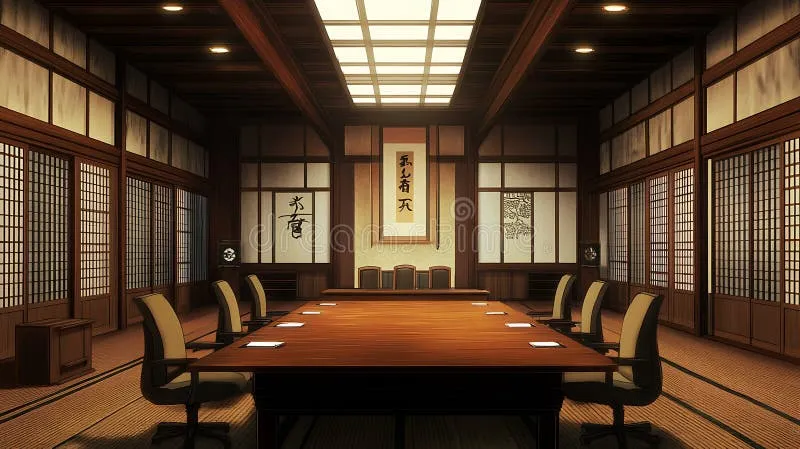
Photo: formal japanese business meeting tatami room seating arrangement, via thumbs.dreamstime.com
Walk into any conference room in Austin or Atlanta and you will see the same scene: people drift to chairs by habit, by laptop charger proximity, or by whoever arrived last scrambling for a seat near the back. Nothing about the arrangement is chosen. Everything about it, however, is communicating.
In Japan, this communication is not left to chance. The practice of kamiza (上座) and shimoza (下座) — the seat of honor and the lower seat — assigns meaning to every position in a room. The kamiza is typically the spot farthest from the door, often with the best view, reserved for the most senior or most honored person. The shimoza, closest to the entrance, belongs to those who serve, arrange, and attend. A Japanese businessperson who enters a room and sits in the wrong chair has, in effect, interrupted a sentence before it was spoken.
American companies rarely think this way. Perhaps they should.
The Room Speaks First
Every meeting room in the United States already has a de facto kamiza — the head of the table, the chair facing the windows, the seat where the CEO's presence is felt even when the CEO is absent. The difference is that in Japan, the assignment is intentional, and intention changes behavior.
When a host deliberately places a client in the seat of honor, the gesture registers somewhere below language. The client does not need to be told they are valued; the room has said it. Conversely, when a manager seats a direct report across from them at equal heights rather than behind a desk, the geometry itself softens the conversation.
This is not about adopting Japanese ritual wholesale. It is about recognizing that spatial decisions are leadership decisions, made constantly and usually by accident.
Three Rooms, Three Arrangements
Consider how deliberate seating might reshape three common American scenarios.
The client pitch. The instinct is to present: team on one side, screen dominating the room, prospects arranged in rows like an audience. A kamiza-informed approach inverts this. Place the clients at the position of honor — the far side of the table from the door, with clear sightlines — and seat your own team on the entry side, nearest to the logistics of water, handouts, and tech support. You are, spatially, saying: this meeting is for you. The presentation becomes a conversation between people seated around a shared table rather than a performance delivered at one.
The difficult review. Performance conversations fail often not because of content but because of staging. A manager behind a desk, employee across and below, recreates the architecture of a courtroom. Instead, choose a corner of a table — seats adjacent rather than opposed — with the employee offered the more comfortable position. The message is subtle but real: we are examining a problem together, not adjudicating a person. Japanese etiquette would call this minimizing the distance between kamiza and shimoza; an American HR leader might call it psychological safety. The geometry is the same.
The partnership negotiation. Here, traditional formality actually helps. Seat the principal negotiators facing one another at the center, with counterparts and counsel flanking in descending order of seniority toward the door. Everyone can read, at a glance, who has authority to decide. American negotiations often stall precisely because decision-making authority is opaque — the person across the table keeps saying they need to check with someone. A legible room reduces that ambiguity before the first term sheet is opened.
Hierarchy Without Rigidity
The obvious objection: American culture prizes flatness, and formal seating seems to contradict it. But the kamiza tradition is less about rigid hierarchy than about clarity of respect. There is a difference between pretending no one is in charge and designing a room where seniority and hospitality are expressed gracefully.
Some of the most effective American leaders already intuit this. The founder who always takes the seat nearest the door — positioning themselves as the one who fetches, arranges, and serves — is practicing shimoza leadership, whether they know the word or not. It reads as humility. It is also strategy: the person who controls the door controls the flow of the meeting.
A Short Practice
Before your next consequential meeting, take five minutes:
- Identify the room's natural seat of honor — usually farthest from the door, best light, clearest view.
- Decide whom the meeting is truly for, and give that person the kamiza.
- Position your own team nearest the door, in the service role.
- For hard conversations, trade opposition for adjacency.
- Notice, afterward, whether the conversation moved differently.
None of this requires a single word of explanation. The room will have said everything — and this time, you will have chosen what it said.
At Miyake, we believe the oldest disciplines often solve the newest problems. The empty chair at the head of the table is never really empty. It is waiting to be filled on purpose.